
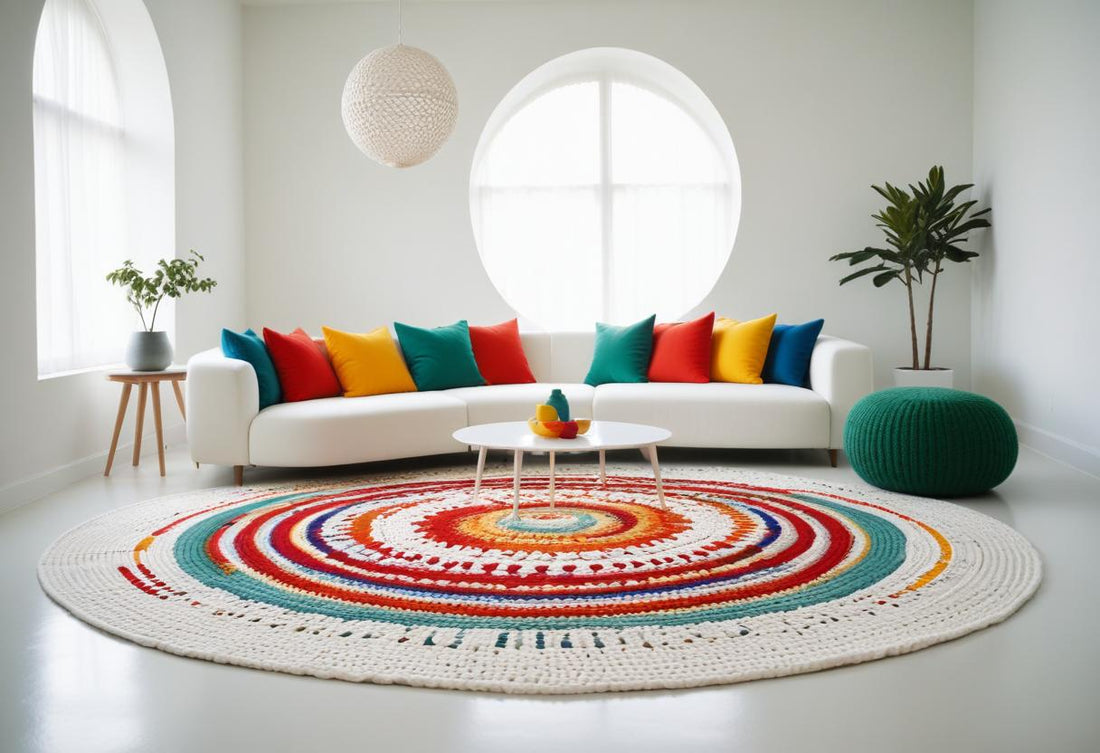
How to crochet the perfect circle step by step
Share
One of the most common questions when crocheting in the round is:
why isn't my circle truly round?
Sometimes it ripples, takes on a hexagonal shape, or shrinks around the edges.
In this article, I explain how to achieve a perfectly round circle in crochet with simple tips and the correct distribution of increases.
Why isn't my circle round?
When crocheting a circular base, we need to make increases in every round so the work grows evenly. An increase consists of crocheting two stitches into the same stitch from the previous round, which keeps the work flat and circular.
The basic increase sequence is:
- 1st round: increase in every stitch.
- 2nd round: increase every 1 stitch.
- 3rd round: increase every 2 stitches.
- 4th round: increase every 3 stitches.
- 5th round: increase every 4 stitches…
- and so on.
⚠️ The problem:
if you always begin the round in the same way, the increases will line up vertically, creating an angular pattern (like a hexagon).
This causes the circle to lose its perfect shape.
Tip 1: Distribute the increases evenly
To achieve a perfectly round circle, vary the beginning of each round.
This is known as “distributing the increases”.
For example: if you need to increase every 6 stitches, don't start directly with 6 stitches + increase. Instead, begin with “3 stitches + increase” and then continue with the normal sequence. This shifts the increases and keeps the circle balanced.
👉 This simple adjustment prevents the increases from falling in the same line and distorting the circle.
Increase and distribution table
Below, you can see how to distribute the increases over the first 12 rounds to create a perfect circle.
This table applies to any type of stitch. If you crochet in single crochet, begin the first round with 6 single crochets; if you crochet in double crochet, begin the first round with 12 double crochets.
| Round | Increase ratio | How to crochet the beginning of the round | Sequence to repeat for the rest of the round | Stitches at the end of the round that complete the beginning |
|---|---|---|---|---|
| 1 | — | 6 sc / 12 dc | — | — |
| 2 | Increases in every stitch | inc + inc |
inc + inc |
— |
| 3 | Increase every stitch | 1 st. + inc | 1 st. + inc | — |
| 4 | Increase every 2 stitches | inc + 2 sts. | inc + 2 sts. | — |
| 5 | Increase every 3 stitches | 2 sts. + inc | 3 sts. + inc | 1 st. |
| 6 | Increase every 4 stitches | inc + 4 sts. | inc + 4 sts. | — |
| 7 | Increase every 5 stitches | 3 sts. + inc | 5 sts. + inc | 2 sts. |
| 8 | Increase every 6 stitches | inc + 6 sts. | inc + 6 sts. | — |
| 9 | Increase every 7 stitches | 4 sts. + inc | 7 sts. + inc | 3 sts. |
| 10 | Increase every 8 stitches | inc + 8 sts. | inc + 8 sts. | — |
| 11 | Increase every 9 stitches | 5 sts. + inc | 9 sts. + inc | 4 sts. |
| 12 | Increase every 10 stitches | inc + 10 sts. | inc + 10 sts. | — |
To calculate how to start the following rounds (if your circle is larger), it is very simple. To determine the beginning of the next row, alternate stitches (adding 1 to the number of stitches from two rows earlier) with increases (adding 2 to the number of stitches from two rows earlier).
Tip 2: How to start the circle
Although the magic ring is very popular, if you are looking for a firmer, flatter base, you can start with chains joined with a slip stitch:
- Chain 3 or 4 stitches.
- Close them into a circle with a slip stitch.
- Work the first round inside this ring.
This way, the center stays dense, flat, and without any raised texture—ideal for bag bases, mandalas, or rugs.
Tip 3: how to close rounds correctly
This is where many people make mistakes without realizing it.
There are two main ways to crochet in the round:
🌀 Option 1: in a spiral (without closing the round)
- Work the rounds one after another, without a joining stitch.
- It is a quick method, but the beginning of the round shifts slightly and a diagonal line may be visible.
- Ideal for single-color projects.
🔸 Option 2: closing each round with a slip stitch
- At the end of each round, join with 1 slip stitch into the first stitch of the round.
- Then make the turning chains (they do not count as the first stitch):
- Single crochet → 1 chain stitch
- Half double crochet → 2 chain stitches
- Double crochet → 2 chain stitches (not 3).
This method leaves the edge perfectly neat, aligns the rounds, and is the most recommended for decorative or multicolored projects.
👉 At Idealium, we use this method for all our circular t-shirt yarn rugs because it keeps the shape perfect and gives a professional finish.
Tip 4: adjust the tension of your work
Balanced tension is just as important as the increases.
- If you crochet too tightly, the circle will curl upward, creating a “bowl” effect.
- If you crochet too loosely, waves or ripples will form.
💡 Practical tip: the fabric should be flexible, but not loose. If you use thick fibres (such as T-shirt yarn or roving wool), relax your hand and let the yarn flow smoothly.
Tip 5: apply these tricks to your projects
Once you’ve mastered the technique, you can use this method for any circular creation:
- Rugs
- Coasters
- Round bags
- Decorative mandalas
- Basket mats or bases
If you want to put it into practice with a real project, you can follow this pattern:
👉 How to crochet a perfect round T-shirt yarn rug
There you’ll find the same principle applied to Trapillo Terra, with a complete pattern, increase table, and step-by-step video tutorial.
Conclusion
With these tips and a little practice, you’ll be able to crochet perfect circles for any project: rugs, baskets, bags, or fashion garments.
Remember: the secret lies in the distribution of increases, the proper closing of the rounds, and the yarn tension.




10 comments
Hola, ¿Sabrías cómo hacer esto pero con agujas de punto? Estoy haciendome una falda sin patrón y quiero que me salga en forma de círculo para que tenga ese tipo de caída luego cuando me la ponga, con agujas circulares, y tengo un lío sobre cómo ir haciendo los aumentos. Gracias!
En el caso de las gorritos al momento de cerrar el círculo queda como una cicatriz y se ve feo. Puedes sugerír algo al respecto por favor
Hola, me encanta la explicación, pero no sé xq siguiendo las pautas como dices tú..pasando de la 6 vuelta me empieza a hacer ondas y tengo q acabar desaciendolo..también preguntarte cómo puedo hacer xejemplo..para q quede bien haciendo una o dos vueltas en punto alto y dos en medio punto y así sucesivamente…gracias y un saludo desde España.
Hola. Me encantan tus tutoriales, pero hay algo que no puedo resolver.
Estoy haciendo mandalas y la mayoría se me hace volado, siempre siguiendo tutoriales. Hago bien los aumentos y todo.
Me gustaría saber si hay una tabla par hacer aumentos calados o no se si me explico.
Desde ya muchas gracias y ojalá pueda solucionar este inconveniente
Holaaa, te felicito por tu página, está todo muy bien explicado, pero hay una cosita que no me queda muy clara, y es si cada vuelta se empieza en la base de las cadenas de subida o en la cadena correspondiente al punto de al lado, o si bien, se alternan. Gracias de antemano!! Saludos